
Today, the Brazilian health ministry released updated numbers on the microcephaly situation in the country; it shows a total of 4,443 suspected and confirmed cases, 3,935 and 50, respectively.

Only a small number of cases can be attributed to causes other than Zika, according to health officials.
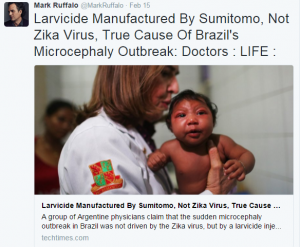
In related news, a report by the University Network of Environment and Health that attempts to link the larvicide pyriproxyfen and the microcephaly outbreak in Brazil has drawn much criticism from the scientific community; it has been called downright dangerous.
Actors Mark Ruffalo and George Takei shared stories promoting the idea on their respective social media pages; they are not scientific experts on the issue.
A number of scientists made statements on the situation.
Ian Musgrave, with the University of Adelaide: “The claims that pyriproxyfen causes microcephaly are simply not plausible.”
“Even enormous quantities of pyriproxyfen do not cause the defects seen during the recent Zika outbreak.”
University of Pittsburgh microbiologist Ernesto Marques, Ph.D., who is studying microcephaly in Brazil, said the larvicide-microcephaly link was false, and reiterated the Brazilian Ministry of Health’s statement that pyriproxyfen has been used for decades with no reports of increased birth defects.
Grayson Brown, Ph.D., with the public health entomology laboratory at the University of Kentucky in Lexington: “The larva-killing toxin is applied to areas where microcephaly already occurs, because that’s where it’s most important to keep mosquito numbers down. The whole notion is misplaced cause and effect.”
Japanese company Sumitomo Chemical, the manufacturer of pyriproxyfen, rebuked the linking of its larvicide to microcephaly, pointing out that the World Health Organization has approved this chemical for mosquito control, and that it has been used in France, Denmark, Spain, Turkey, the Dominican Republic and Colombia.